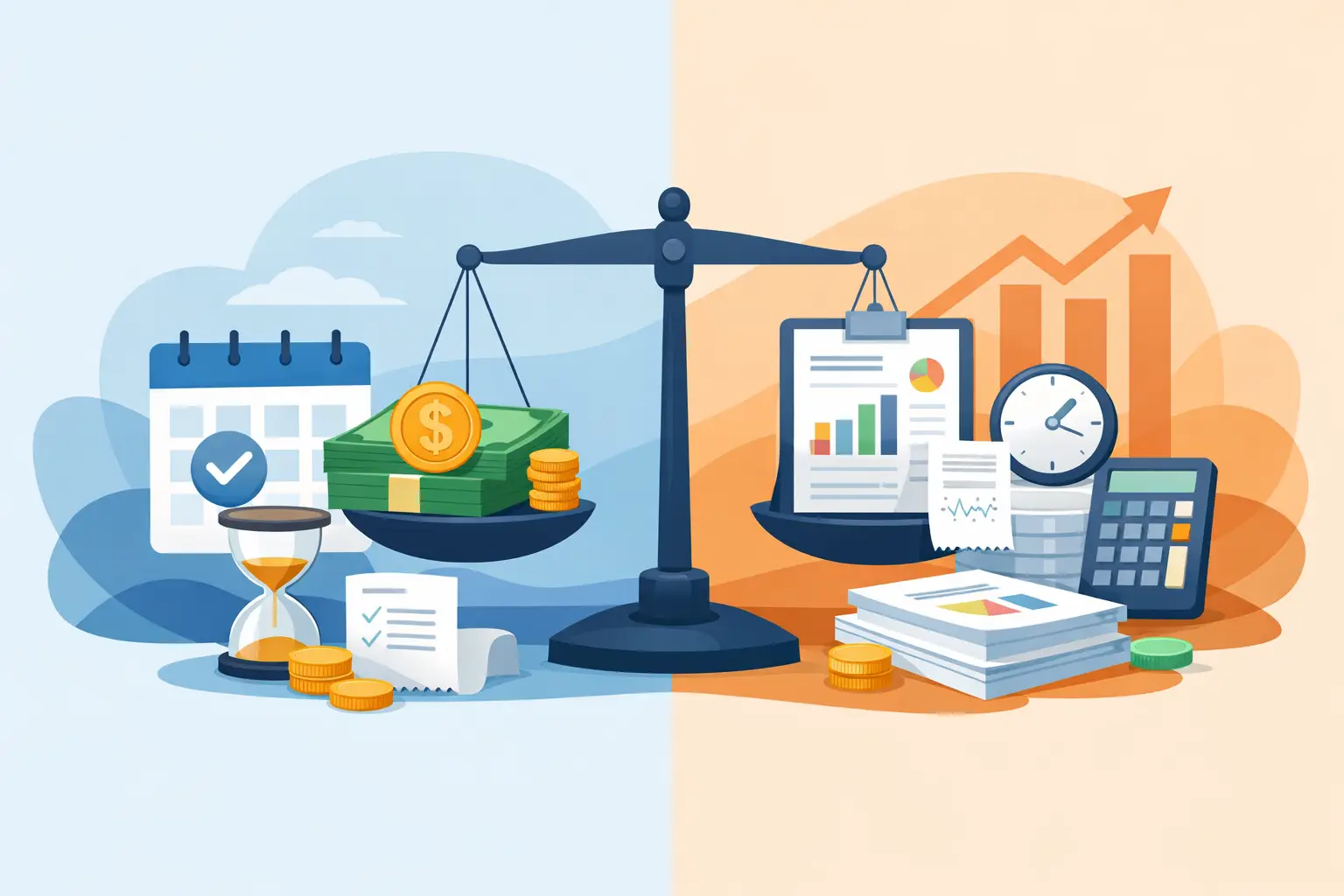
A profitable month can still feel tight when customers have not paid their invoices. On the other hand, a strong bank balance can create false confidence if major bills are waiting to be recorded. That is the practical difference behind cash versus accrual accounting: each method tells a different, useful story about your business.
For Cleveland business owners, the right approach is not simply the one that feels easiest. Your accounting method affects tax timing, financial reporting, cash planning, lender conversations, and the decisions you make every day. The goal is to use a method that keeps your records accurate, supports compliance, and gives you information you can act on.
What Cash Accounting Shows You
Cash accounting records income when your business receives payment and records expenses when you pay them. If you send an invoice in December but your customer pays in January, the income is generally recorded in January. If you receive a vendor bill in December but pay it in February, the expense is generally recorded in February.
This approach closely follows your bank account. Many service-based businesses and sole proprietors prefer it because it is straightforward to understand and easier to manage without a large internal accounting team. When you look at your books, you can quickly see money that has actually moved in or out.
Cash accounting can also provide useful flexibility for tax planning. If year-end is approaching, the timing of customer payments and business purchases may affect the income and deductions shown for that tax year. That does not mean payments should be delayed or expenses accelerated without a clear business reason. It means business owners should understand how timing affects their taxable income before making decisions.
The limitation is that cash accounting may not show obligations and earned revenue as they develop. A business could appear to have a great month because it collected several older invoices, even if current sales have slowed. It could also appear highly profitable while significant vendor bills, payroll-related costs, or other commitments have not yet been paid.
What Accrual Accounting Shows You
Accrual accounting records revenue when it is earned and expenses when they are incurred, regardless of when cash changes hands. If your company completes work and invoices a client in December, the revenue is recorded in December. If you receive materials or services in December, the related expense is recorded in December, even if payment happens later.
This method creates a clearer match between the revenue earned during a period and the costs required to generate it. For companies with invoicing cycles, inventory, contracts, recurring vendor expenses, or multiple employees, that perspective can be valuable. It helps owners evaluate whether operations are truly profitable, not merely whether the bank account happened to rise that month.
Accrual accounting tracks accounts receivable, which are amounts customers owe you, and accounts payable, which are bills your business owes. Those balances help you monitor collection issues, upcoming payment demands, and working capital needs. A contractor, professional practice, distributor, or growing service company may find this visibility especially helpful.
The trade-off is added complexity. Accrual records require regular reconciliation and a disciplined process for recording invoices, bills, prepayments, deposits, and adjustments. Without consistent bookkeeping, an accrual-based profit and loss statement can become just as misleading as a poorly maintained cash-basis set of books.
Cash Versus Accrual Accounting: The Day-to-Day Difference
Consider a landscaping company that completes a $12,000 commercial project in late November and invoices the customer on November 30. The customer pays on January 15. The company also receives a $4,000 supplier bill for materials in November but pays it in January.
Under cash accounting, neither the $12,000 payment nor the $4,000 supplier payment appears in November. November may look less active than it actually was. Under accrual accounting, the $12,000 revenue and $4,000 material expense are recorded in November, when the work was completed and the materials were used. That gives the owner a more accurate view of the project’s margin.
Neither view is wrong. Cash accounting answers, “What cash moved?” Accrual accounting answers, “What did we earn and owe during this period?” Well-managed businesses often need to pay attention to both questions, even when their official books and tax return use one method.
Choosing the Method That Fits Your Business
Cash accounting may be a practical fit when your business has simple transactions, receives payment at or near the time of service, carries little or no inventory, and wants a direct view of available cash. It is often easier for owner-operated businesses that need reliable records without unnecessary administrative burden.
Accrual accounting may make more sense when your business invoices customers, pays vendors after receiving goods or services, manages inventory, works on longer projects, or needs financial statements for a lender, investor, partner, or larger customer. It can also give management a better basis for pricing, budgeting, and measuring performance over time.
The decision is not always entirely optional. Tax rules may require certain businesses to use an accrual method, particularly in situations involving inventory or specific entity and revenue circumstances. Rules and exceptions can change, so it is wise to review your situation with a qualified tax and accounting professional rather than selecting a method based only on convenience.
Your industry matters, too. A salon that collects at the point of service has different reporting needs from a manufacturer purchasing materials months before selling finished products. A medical practice waiting on insurance reimbursements faces different cash-flow pressures than a retailer that accepts immediate card payments. The best method reflects how your business actually operates.
Do Not Confuse Profit With Cash Flow
One of the most common financial mistakes is treating profit and cash as if they mean the same thing. They do not.
A business can be profitable on an accrual basis but short on cash because customers have not paid their invoices. It can also have cash in the bank from a loan, owner contribution, or advance customer payment while its core operations are not profitable. Looking at only one number can lead to poor decisions about hiring, equipment purchases, tax payments, or owner draws.
For this reason, businesses using accrual accounting should still maintain a simple cash forecast. Review expected customer payments, payroll, rent, debt payments, taxes, supplier obligations, and planned purchases. A forecast does not need to be complicated to be useful. It needs to be current enough to identify pressure before it becomes a problem.
Businesses using cash accounting should also track unpaid invoices and outstanding bills outside the basic profit and loss statement. If a customer owes you a substantial amount, that receivable matters even though it has not yet become cash. If several vendor bills are due next week, your bank balance alone is not a complete picture.
Changing Methods Requires Careful Planning
Switching from cash to accrual accounting, or from accrual to cash, is more than changing a setting in bookkeeping software. It can affect how income and expenses are reported for tax purposes, including adjustments that prevent items from being counted twice or missed altogether.
A change may require IRS approval or a formal filing, depending on the circumstances. It can also affect comparative financial statements, loan reporting, and internal performance tracking. Before making the switch, review why you are changing, what records need to be cleaned up, and how the transition will affect your current-year tax position.
This is also a good time to strengthen your bookkeeping process. Reconcile bank and credit card accounts regularly, issue invoices promptly, review unpaid customer balances, enter vendor bills consistently, and keep personal and business transactions separate. The accounting method only works when the underlying records are complete.
Use Your Books to Make Better Decisions
The strongest accounting system is one you can trust. It should help you prepare for taxes, pay employees correctly, understand your operating results, and spot issues early enough to address them. That may mean using cash-basis records for tax reporting while reviewing management reports that include receivables, payables, and cash forecasts.
JPC Advisers helps business owners bring tax planning, bookkeeping, payroll, and day-to-day financial management into one practical conversation. The right method depends on your business model, goals, and compliance requirements, not on a one-size-fits-all rule.
A clear set of books will not remove every financial decision, but it will replace guesswork with useful information. Start by asking whether your current records show both what your business earned and what it can afford to do next.
